
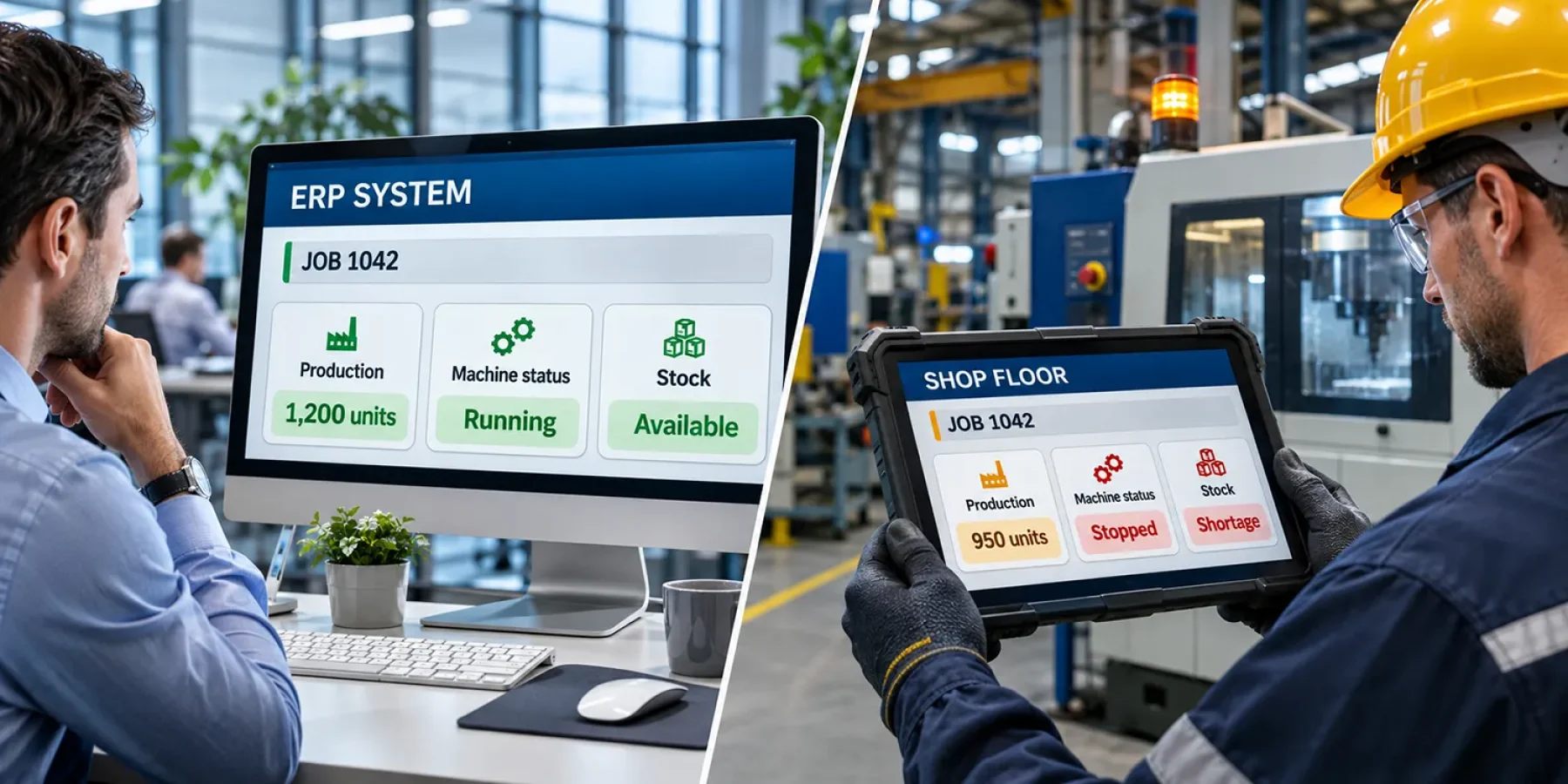
Factories are making more and suppliers are slower. The distance between what Syspro believes and what the floor did widens every shift, without a single alarm.
Key Findings
- Growth is the Gap’s favorite food. U.S. manufacturing expanded for the 10th straight month in October, and the ISM Production Index hit 59.0, its highest reading since November 2021. More output means more moves, issues, completions and receipts that Syspro has to hear about.
- Suppliers are making it harder. Deliveries slowed for the 11th month in a row. Average lead time for production materials rose to 87 days, and 41 percent of negative survey comments cited longer lead times. Every late delivery reshuffles the floor, and every reshuffle is a transaction that can go missing.
- The Gap is silent. No screen turns red when a pallet moves unrecorded. In one study of nearly 370,000 retail inventory records, 65 percent did not match what was physically there.
- The ERP is not broken. It is uninformed. Syspro is exactly right about the transactions it received. The Gap lives in the ones it never got, or got hours late.
- The fix is capturing each event where the work happens. One scan then posts every Syspro transaction that event requires.
- You can measure it this week. Pick one workflow. Time how long a floor event takes to reach Syspro, and count the operator touches it takes to get there.
Meet the villain: the Gap
The Gap is the distance between what your ERP believes is happening and what is actually happening on your factory floor. In a Syspro shop, it is the pallet Syspro places in Bin 14 that left for Line 3 an hour ago. It is the job Syspro shows as open that finished before lunch.
The Gap does not announce itself. It grows one unrecorded move at a time. Nobody notices until a planner promises stock that is gone, or a stocktake turns into a write off.
We have written about it before in Your ERP Knows What You Planned. Does It Know What Actually Happened? What has changed is the pace. When the floor speeds up, the Gap speeds up with it.
Growth is the Gap’s favorite food
On November 2, the Institute for Supply Management published its October 2026 Manufacturing PMI Report. On the surface it is good news.
| ISM indicator, October 2026 | Reading | What it means on your floor |
| Manufacturing PMI | 55.5 (Sept: 54.5) | 10th straight month of expansion |
| Production | 59.0 (Sept: 56.7) | Highest since November 2021: more jobs moving through work centers |
| New Orders | 55.5 | More demand to promise against |
| Supplier Deliveries | 59.1 | Slower deliveries for the 11th month: more schedule changes |
| Prices | 75.2 | Raw material prices up for the 25th month: every lost unit costs more |
| Production materials lead time | 87 days, up 3 | Less room to recover from a wrong stock number |
Read that table again from the floor’s point of view. More output means more material issues, labor postings, moves and finished goods receipts. Slower suppliers mean more reprioritized jobs and redirected material. Higher prices mean every phantom unit in Syspro is more expensive to discover.
The survey comments say the same thing in plainer words. ISM reports that 41 percent of negative comments mentioned longer lead times. One machinery respondent described customers complaining about delivery delays while the company works hand to mouth.
None of that pressure shows up as an error message in Syspro. It shows up as more transactions, entered later, by busier people.
Why the Gap stays silent
Most operational problems make noise. A machine stops. A truck is late. The Gap is different, for five reasons.
- The ERP is right about what it was told. Syspro reports exactly the transactions it received. A move that was never keyed simply does not exist to the system.
- People absorb the error. A picker who cannot find stock walks to the next bin. A supervisor keeps a side spreadsheet. The workaround hides the problem.
- Counts happen rarely. Many plants learn the true size of the Gap once or twice a year, at stocktake, long after the cause is gone.
- Reports show quantity, not freshness. An inventory report says 400 units. It does not say the number is six hours old. We made this point in Your Inventory Report Tells You What You Have. It Doesn’t Tell You When Production Stops.
- It is everywhere at once. No single bad transaction looks serious. Hundreds of small ones do.
The research backs this up. When Nicole DeHoratius and Ananth Raman studied nearly 370,000 inventory records across 37 stores of one retailer, they found 65 percent of the records were inaccurate (Management Science, 2008). They also found that the complexity of the store environment and the distribution structure drive the errors up. A factory floor under schedule pressure is more complex than a retail shelf.
Gartner has estimated the average annual cost of poor data quality at $15 million per organization. That figure is not specific to manufacturing. The direction is the point: bad records are expensive long before anyone sees them.
How the Gap opens on an ordinary Tuesday
No system fails in this story. Every step is normal.
- 7:00 AM. Syspro shows enough material for the day’s plan.
- 8:15 AM. A supplier calls. Today’s delivery will be late.
- 8:45 AM. The supervisor swaps two jobs to keep the line running.
- 9:10 AM. The warehouse moves material between work centers for the new sequence. Nobody posts the transfer yet.
- 9:30 AM. An operator issues extra components because actual use beat the bill of materials.
- 10:00 AM. A job finishes. The finished goods receipt waits for the end of shift.
- 10:15 AM. A planner checks Syspro to promise a customer order.
At 10:15 the planner is looking at a factory that existed at 7:00. Material that was consumed still looks available, stock appears in a bin it left an hour ago, and finished goods sit on the floor but not in the system.
The planner makes a reasonable decision on bad information. That is how the Gap turns into a missed delivery without anyone making a mistake.
Two gaps that feed each other
In Your Factory Was Built on Assumptions. What Happens When They Change?, we separated two problems.
- The Operational Gap is the difference between the physical floor and what Syspro records.
- The Assumption Gap is the difference between the conditions management planned for and the conditions the plant now faces. The plan assumed a 12 day supplier lead time. It is now 19. The plan assumed an 18 minute cycle. It now takes 24.
The first gap hides the second. If you cannot trust what happened this morning, you cannot tell whether your planning assumptions have drifted. The Federal Reserve’s latest industrial production release put manufacturing capacity utilization at 75.9 percent in September, below its long run average of 78.2 percent. Some of that is demand. Some of it is plants that cannot say exactly why, because the floor data is late.
How long does your Gap stay open?
Most plants measure inventory accuracy, throughput and on time delivery. Few measure a number that sits underneath all three: the time between a physical event and Syspro knowing about it. We call it Floor to Syspro Lag.
| Floor event | What goes wrong while Syspro waits |
| Material received | Production cannot confirm what is usable |
| Material moved | People search for stock that already left |
| Components consumed | Syspro overstates what is left |
| Job completed | Planners still see work in process |
| Finished goods received | Customer promises rest on old numbers |
Sometimes the lag is minutes. Often it is a shift. Sometimes a correction lands days later. Some lag will always exist, and the test is whether it touches a decision that matters.
That gives every plant two goals.
- Shrink the Gap. Capture each event as close to the work as practical, validated against Syspro’s rules.
- Simplify the work. Cut the number of touches it takes to keep Syspro current.
Do one without the other and you leave value on the table. Accurate data that takes six screens to enter will not stay accurate when the floor gets busy.
Closing the Gap without adding work
If production rises 20 percent, data entry should not rise 20 percent with it.
When an operator finishes an operation, Syspro may need several transactions: a material issue, a labor posting, a job update and, at the last operation, a finished goods receipt. Asking a busy operator to key each one separately is how the Gap gets fed.
TransLution configures one scan to post every validated Syspro transaction that event requires. The operator does the physical work. The workflow handles the system work. Syspro hears about it right away.
One scan. Every transaction. No Gap.
That is different from barcode scanning on its own. Scanning digitizes a transaction. A configured workflow removes the transactions a person should never have had to key. Our October post, Manufacturing Orders Are Rising. Supplier Delays Are Getting Worse. How Much of Your Capacity Is Your ERP Consuming?, shows how much operator time that frees up.
Dewhurst: every issue and receipt, scanned and posted
Dewhurst, a UK manufacturer of components for the elevator industry, went live with TransLution across production and inventory in October. Its goal was simple: every job issue and receipt scanned and posted straight to Syspro.
- An inbound scan logs a job into a work center and issues the component kit at the first operation.
- An outbound scan posts labor as the job leaves and receipts finished goods into stock at the last operation.
- Jobs can be combined into one pick, with short picks shared across jobs in the order they were scanned.
Dewhurst has not yet published results, so we will not quote any. The design is the lesson: the Gap closes because the transaction happens where the work happens.
LANCEWOOD: from days to hours
LANCEWOOD, one of South Africa’s largest cheese and dairy producers, used to update its production plan by hand in spreadsheets. It took three to five days. With live production data feeding the planning model the team already used, the update now takes about three hours.
In a perishable, high volume business, a plan that is five days old is a guess. A plan that is three hours old is a decision. That is why we keep coming back to one formula:
Predictability = Visibility + Control.
Visibility is knowing what is happening. Control is having the time to act on it.
Five levels of manufacturing execution maturity
Find where your plant sits today. Each level is measured two ways: how wide the Gap is, and how much extra work it takes to keep Syspro right.
| Level | How wide the Gap is | Extra work to keep Syspro right | What improves at this level |
| 1. The Blind Spot | Days | Everything is written down, then rekeyed | You get a baseline for the first time |
| 2. The Data Chaser | Hours | Hours of corrections and reconciliations every day | Fewer fixes, fewer surprise stock outs |
| 3. The Connected Floor | Minutes | Screen after screen for every job step | Live visibility, faster counts |
| 4. The Workflow Optimizer | Near zero | One scan per step completes every transaction | Same team, more output, shorter cycles |
| 5. The Predictable Factory | Closed and watched | Effort shifts from admin to improvement | Plans in hours, not days |
The big step is from Level 3 to Level 4. A connected floor knows what happened. An optimized floor makes the right transaction the easiest one to do.
Levels 1 to 3 build Visibility. Levels 4 and 5 add Control. Together they give you Predictability.
A mature factory is not one where nothing changes. It is one where change never leaves Syspro behind.
Find your Gap before your next production meeting
The Big Five of Operational Truth will surface it in one meeting. Pick one critical material, product or work order, and ask:
- What do we have? Not what last night’s report said, but what exists and is usable now.
- Where is it? Whether Syspro can tell you the physical location.
- Who is using it? Which jobs, work centers or customer orders depend on it.
- Is it where Syspro thinks it is? This is the Gap, asked out loud.
- What is the difference costing us? Count the searching, correcting, expediting and waiting.
Then add two measures of speed and effort, since slow or uncertain answers are the Gap made visible.
- How long a floor event takes to show up correctly in Syspro.
- How many operator touches it takes to get it there.
Growth should not leave your ERP behind
The October numbers are good news. Plants are busier than they have been in years. But busier is not simpler. Suppliers are slow, prices are high, and schedules change by the hour.
Every one of those changes is an event Syspro needs to hear about. The goal is to make the floor and Syspro move together. Capture the event where it happens, validate it and post every Syspro transaction it requires. That takes the extra steps away from the operator and gives managers numbers they can act on now, not next week.
How wide is the Gap in your factory?
Take one workflow, time it from floor to Syspro, count the touches and list the corrections. Then talk to us about the Five Question Factory Assessment.
Your floor. Your facts. Right now.
Frequently Asked Questions
What is the gap between an ERP and the shop floor?
The gap is the difference between what an ERP such as Syspro records and what physically happened on the factory floor. It opens when material moves, component use, labor, job completions or receipts are recorded late, wrong or not at all. TransLution calls it the Gap.
Why is the gap between ERP and the factory floor so hard to see?
Because the ERP is accurate about the transactions it received and has no way to know about the ones it missed. People work around missing stock, counts happen rarely, and reports show quantities without showing how old they are. The gap usually surfaces at a stocktake or a missed delivery.
Why does manufacturing growth make ERP inventory less accurate?
More production means more transactions, and slower suppliers mean more schedule changes and redirected material. In October 2026, ISM reported production at its highest level since November 2021 while supplier deliveries slowed for the 11th month. More events entered by busier people means more chances for Syspro to fall behind.
How common is inventory record inaccuracy?
It can be very common. A Management Science study of 37 stores of one retailer, by DeHoratius and Raman, found that 65 percent of nearly 370,000 inventory records were inaccurate. The authors also found that the complexity of the store environment and the distribution structure push errors higher.
What is Floor to Syspro Lag and how do you measure it?
Floor to Syspro Lag is the time between a physical event, such as a job completion, and Syspro reflecting it correctly. To measure it, pick one workflow, note when the physical event happens and when the transaction posts, and track the difference and the corrections over a week.
How do you close the gap between Syspro and the factory floor?
Capture each event where the work happens, validate it against Syspro’s rules, and post every transaction the event requires right away. TransLution does this with configured scanning workflows, so one scan can post a material issue, a labor entry, a job update and a finished goods receipt.
Can one barcode scan post several Syspro transactions?
Yes. With TransLution, one scan can be configured to post several related, validated Syspro transactions, such as material issues, labor postings, production updates and finished goods receipts. Dewhurst uses an inbound scan to issue component kits and an outbound scan to post labor and receipt finished goods.
How is workflow optimization different from barcode scanning?
Barcode scanning records one event digitally. Workflow optimization decides which business transactions that event should trigger, then replaces several manual steps with one. Scanning makes entry faster. Optimization removes entries an operator should never have had to make.
What are the Big Five of Operational Truth?
The Big Five are what do we have, where is it, who is using it, is it where Syspro thinks it is, and what is the difference costing us. Slow or uncertain answers show where Syspro and the floor disagree.
What are the five levels of manufacturing execution maturity?
The TransLution model has five levels: The Blind Spot, The Data Chaser, The Connected Floor, The Workflow Optimizer and The Predictable Factory. Each level is judged by how wide the Gap is and how much extra work it takes to keep the ERP right. The biggest jump is Level 3 to Level 4, where one scan completes every transaction a step requires.
Does TransLution work with Acumatica as well as Syspro?
Yes. TransLution is built for Syspro and also supports Acumatica, so the same approach to capturing floor events and posting validated transactions applies to Acumatica manufacturers.
Sources
Outside sources
- Institute for Supply Management, Manufacturing PMI at 55.5%; October 2026 ISM Manufacturing PMI Report, November 2, 2026
- Nicole DeHoratius and Ananth Raman, Inventory Record Inaccuracy: An Empirical Analysis, Management Science, 2008
- Gartner, How to Stop Data Quality Undermining Your Business
- Federal Reserve Board, Industrial Production and Capacity Utilization, G.17, October 16, 2026
TransLution posts linked in this article
- Your ERP Knows What You Planned. Does It Know What Actually Happened? (August 19, 2026)
- Predictability = Visibility + Control: The LANCEWOOD Case Study (August 28, 2026)
- Your Inventory Report Tells You What You Have. It Doesn’t Tell You When Production Stops. (September 2026)
- Your Factory Was Built on Assumptions. What Happens When They Change? (September 22, 2026)
- Dewhurst Goes Live with TransLution Across Production and Inventory Operations (October 8, 2026)
- The Big Five of Operational Truth: Five Questions Every Manufacturer Should Answer Before the Morning Production Meeting (October 2026)
- Manufacturing Orders Are Rising. Supplier Delays Are Getting Worse. How Much of Your Capacity Is Your ERP Consuming? (October 29, 2026)