Lora Cecere says universities are not teaching supply chain leaders systems thinking. Even those who learn it will plan from an ERP that lags the floor.
Key findings
- The grades are in, and they disagree. On a recent Supply Chain Now episode, three supply chain academics gave university programs a B+. Lora Cecere gave them a C minus or D plus.
- Talent is only half the problem. Even the best trained leader cannot optimize a factory the ERP cannot see. When physical work and Syspro transactions drift apart, every function plans from a different version of reality. We call that The Gap.
- Inaccurate records are the norm. The most cited study of inventory records found 65% of nearly 370,000 records did not match what was physically there.
- AI raises the stakes. Gartner predicts that through 2026, organizations will abandon 60% of AI projects unsupported by AI ready data. Lora Cecere warns against layering AI on top of outdated systems.
- The fix starts where the work happens. Capture each physical event once, at the point of work, and let it post the right Syspro transactions. One scan, multiple transactions.
- Five questions tell you whether you have operational truth. If you cannot answer them with confidence, more AI will only make an imperfect process run faster.
| THE SHORT ANSWER: Is this a talent problem or an operational truth problem? Both matter, but training cannot fix records that lag the floor. When physical work is captured late or not at all, every function plans from a different version of reality, and AI optimizes the wrong picture. The fix is to capture each event once, where the work happens. |
A university professor gives supply chain education a B+. An industry analyst with decades in the field gives it a C minus or D plus.
That was the debate on a recent Supply Chain Now episode cohosted by Lora Cecere, founder of Supply Chain Insights. Her panel was three academics with deep industry roots: Chris Gaffney of Georgia Tech, Jake Dean of the University of Wisconsin at Madison, and Matt Waller of the University of Arkansas. The academics were unanimous at B+. Cecere was not.
In her November 9 follow up, Grading Academia in Preparing Supply Chain Leaders, she explains why. Programs teach students to optimize individual functions and study historical performance. They rarely prepare them to manage an interconnected system, inside companies that are often misaligned and political.
She is asking an important question about education. Manufacturers have a related problem. A leader trained to make better decisions still depends on systems that may not reflect what is happening on the factory floor.
Is bad data really the problem, or is it how the data gets created?
The short answer: bad data is usually a symptom. In most manufacturing operations, the records in the ERP are only as good as the moment physical work gets captured. When capture is late, or skipped because it takes too many screens, the ERP drifts away from the floor.
Cecere is blunt about the excuse. “Project failed? Blame it on bad data.” She is right to challenge it. She also notes that 80% of supply chain data goes unused. Before investing in another analytics platform or AI application, it is worth tracing where the data came from.
Take a manufacturer running Syspro. The ERP may hold accurate financial records, approved production orders, inventory transactions, and material requirements. Every one of those records depends on a physical activity being captured and posted correctly.
An operator moves material and records it later, or not at all. A job is complete on the floor but still open in the system. A supervisor keeps a spreadsheet because updating the ERP takes too many steps.
Spreadsheets are not a fringe habit. In a webinar with GAINS, Cecere said that in interviews she ran early in the pandemic, 94% of the companies she spoke with had moved to managing their operations in Excel. The ERP can be technically correct while the operational picture is incomplete. We made the same case in Your ERP Ledger Can Balance Perfectly. Your Factory Can Still Be Wrong.
This is not a rare problem. In the most cited study on the subject, Nicole DeHoratius and Ananth Raman examined nearly 370,000 inventory records across 37 stores of one retailer and found 65% were inaccurate. A 2025 review by Glock, Syntetos, and Rekik puts the range at 50% to 70% of SKUs at any point in time in retail.
Those studies come from retail. A factory adds work in progress, job issues, and production receipts, which means more places for the record and the floor to disagree. Operational truth means the ERP matches the floor at the moment the work happens.
How can efficient departments make the whole business worse?
Because each function can hit its own target while pushing cost and delay onto the next one. Cecere puts it plainly in her post: “The Efficient Supply Chain is not the Most Effective.”
- Procurement cuts purchase costs and creates production disruptions.
- The warehouse minimizes labor and slows down manufacturing.
- Production maximizes equipment utilization and builds inventory nobody needs.
Every department can meet its numbers while the business performs worse. Systems thinking is the answer to that, and it depends on reliable information about how activities connect.
Follow one component through a plant. It is received into inventory, moved to a production location, issued to a job, worked through manufacturing, and received as finished goods. Each physical step may require one or more Syspro transactions, and any of them can be posted late or wrong.
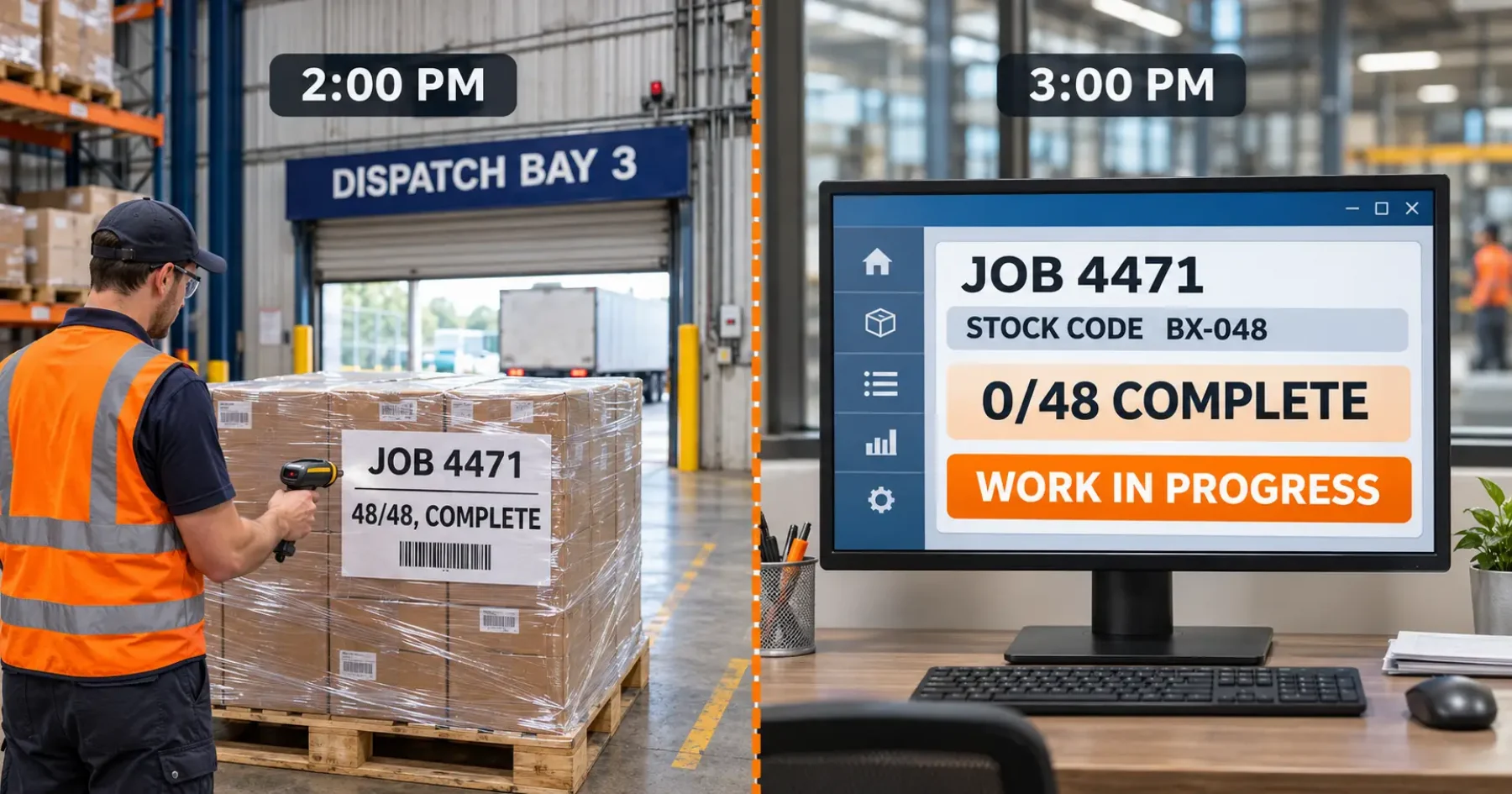
Take an illustrative afternoon. At 2 p.m. an operator wraps the last pallet on a job and leaves it in the dispatch bay. The job receipt waits until the supervisor keys it at the end of the shift. At 3 p.m. the planner still sees the job as work in progress and pushes the next order back. A buyer, seeing no finished stock, expedites material the plant already has.
Each of them made a sensible decision from the record in front of them. That is The Gap between what Syspro says and what is happening on the floor, and it grows quietly as production rises.
Cecere sees the same pattern in supply chain software. In her post on the myth of end to end supply chain planning, she observes that “Each system has a different definition of location, item, events, order, and purchase orders.” When the definitions differ and the postings lag, no function sees the whole system.
What does “one scan, multiple transactions” mean?
It means a single action on the floor can post every Syspro transaction that event requires, instead of asking an operator to complete each one separately.
TransLution provides configurable workflows that connect physical activity to the right Syspro transactions, so operators do not have to work through several ERP screens. When an operator completes a manufacturing step, that single interaction can, where configured and validated:
- Record material consumption
- Update job progress
- Capture labor
- Record completed production
- Update the related inventory movements
The operator does the work once, and planning, purchasing, and finance see it when it happens.
This matters because people still do most of the work. Deloitte’s 2026 Manufacturing Industry Outlook expects more than 81% of task hours in manufacturing to remain human driven. If capture does not fit how people work, it will not happen on time. We estimated that in an illustrative 40 operator plant, keying transactions into the ERP consumes about three operators’ worth of time every shift.
The goal is not to replace Syspro. It is to help Syspro reflect what is happening in the factory, accurately and with less effort.
Can AI fix a factory it cannot see?
No. AI can only optimize the factory its data describes, and if that data lags the floor, the recommendation is built on the wrong picture. Manufacturers are investing in forecasting models, production optimization, predictive maintenance, autonomous agents, and advanced analytics, and the potential is real.
Ask an AI system to optimize production with inventory records that don’t show where material actually is. Or ask an agent to build a schedule when job completions are routinely posted a day late. The recommendation may be sophisticated, even mathematically optimal, and still be optimizing an incomplete version of the factory.
Gartner sees the same risk across industries. It predicts that through 2026, organizations will abandon 60% of AI projects unsupported by AI ready data. In the same research, 63% of organizations said they either lack the right data management practices for AI or are not sure whether they have them.
Cecere makes the point from the planning side. In Syncing to Market Actuals, she warns: “Don’t fall prey to the narrative of layering AI on top of outdated systems.” In Teaching Your Organization to Jump, she cautions that companies often automate outdated workflows with AI agents instead of redefining the process first.
We asked the same question in Your ERP Knows What You Planned. Does It Know What Actually Happened? Before you automate decisions, make sure the events behind them are captured accurately. That rarely takes another major transformation. Usually it means removing operator steps and connecting physical workflows directly to ERP transactions, so the planning systems read what happened on the floor.
What five questions should every manufacturer be able to answer?
Every manufacturer should be able to say, with confidence, what they have, where it is, who is using it, whether it matches the ERP, and what it costs. We call these the Big Five of Operational Truth.
1. What do you have? Not what the inventory report says. What physically exists?
2. Where is it? Can you find the actual location of materials, work in progress, and finished goods?
3. Who is using it? Which operators, jobs, or production activities are consuming resources?
4. Is it where your ERP thinks it is? Does the physical state of the factory match the transactions in Syspro?
5. What is it costing you? What do unnecessary movements, delayed transactions, rework, reconciliation, and administrative effort add up to? In Are You a Supply Chain Nowhere Man? Cecere reports that four metrics, revenue growth, operating margin, inventory turns, and return on capital employed, explain over 40% of market capitalization.
If you cannot answer these reliably, another layer of AI will make an imperfect process run faster. How long would your team need to answer all five before tomorrow’s production meeting? Work through them for your own plant with our Five Question Factory Assessment.
Better leaders need better operational systems
Cecere is right that tomorrow’s supply chain leaders need stronger systems thinking. They must understand how procurement, manufacturing, logistics, finance, and customer demand interact, and challenge historical practices rather than automate them. As she puts it, “Companies confuse historic practices with best practices.”
Her answer is first principles thinking: start from how work actually happens, not from how the system was configured years ago. In her October post on AI in planning, she asks whether this is a chance to redefine work. She also ties supply chain goals to growth, margin, inventory turns, and return on capital rather than functional cost.
Companies have a responsibility too. A manager asked to optimize inventory needs physical movements captured promptly. A production team asked to improve efficiency cannot also be buried in administrative transactions. And an AI model needs inputs that reflect what is happening on the floor.
Predictability = Visibility + Control
That formula is the operating principle behind TransLution. It is how LANCEWOOD cut its production planning cycle from three to five days to about three hours.
| LANCEWOOD PRODUCTION PLAN UPDATES: 3 TO 5 DAYS → ABOUT 3 HOURS |
Connecting physical manufacturing workflows to Syspro improves transaction accuracy, reduces manual effort, and gives planning, analytics, and automation a more reliable foundation. Deloitte’s 2025 Smart Manufacturing Survey of 600 executives at large US manufacturers found smart manufacturing initiatives delivered average gains of 10% to 20% in production output. Those gains depend on knowing what the floor is actually doing.
Cecere is asking whether we are preparing the next generation of supply chain leaders for the world they will inherit. Manufacturers also have to give those leaders systems that show the world they are actually managing.
You can hire the smartest supply chain professional in the world. You can give them the most sophisticated planning software. You can even give them AI. But if the factory and the ERP are telling two different stories, they are still making decisions with one eye closed.
TransLution helps Syspro manufacturers close the gap between physical execution and enterprise information. See how one scan can post multiple Syspro transactions, or request a demo.
Your floor. Your facts. Right now.
Frequently asked questions
What is operational truth in manufacturing?
Operational truth is an accurate, timely record of what is physically happening in a manufacturing operation. It covers where inventory sits, what material has been consumed, how far each job has progressed, and what work is complete, all matched to the transactions in the ERP.
Why does ERP inventory differ from physical inventory?
ERP inventory differs from physical inventory when physical events are not captured at the moment they happen. Common causes include delayed postings, unrecorded material moves or consumption, manual entry errors, and workarounds such as side spreadsheets. Research in retail has found 50% to 70% of SKUs carry inaccurate records at any point in time.
What is The Gap in manufacturing?
The Gap is the difference between what the ERP says and what is actually happening on the factory floor. It grows when capturing work takes too many steps, and it causes each function to plan from a different version of reality.
How does TransLution work with Syspro?
TransLution connects shop floor and warehouse activity to Syspro through configurable workflows. A single scan or interaction can post several related Syspro transactions, such as material issues, labor, job progress, and production receipts, where configured and validated.
Can AI improve manufacturing without accurate shop floor data?
AI can help in some areas, but recommendations on inventory, scheduling, and material requirements are only as good as the shop floor data behind them. Gartner predicts that through 2026, organizations will abandon 60% of AI projects unsupported by AI ready data.
How can manufacturers improve supply chain visibility?
Manufacturers improve visibility by capturing physical events where the work happens, validating transactions as they post, removing duplicate manual steps, and keeping the ERP in step with the floor. A simple starting point is to test whether you can answer the Big Five questions with confidence.
What did Lora Cecere say about supply chain education?
Lora Cecere gave university supply chain programs a C minus or D plus on a Supply Chain Now episode where three academics gave a B+. In her November 9, 2026 post, she argues programs teach functional optimization and historical analysis but not the systems thinking needed to run an interconnected supply chain.
Sources
Outside sources
- Lora Cecere, Grading Academia in Preparing Supply Chain Leaders, November 9, 2026
- Lora Cecere, The Myth of End to End Supply Chain Planning
- Lora Cecere, Syncing to Market Actuals
- Lora Cecere, Teaching Your Organization to Jump
- Lora Cecere, Are You a Supply Chain Nowhere Man?
- Lora Cecere, Supply Chain Shaman, AI: Defining a Middle Ground Between Custom and Packaged Applications in Supply Chain Planning
- GAINS, Is “Set It and Forget It” Right for Today’s Supply Chains?
- Nicole DeHoratius and Ananth Raman, Management Science, Inventory Record Inaccuracy: An Empirical Analysis
- Christoph Glock, Aris Syntetos and Yacine Rekik, On the measurement of inventory record inaccuracies, 2025
- Gartner, Lack of AI-Ready Data Puts AI Projects at Risk, February 26, 2025
- Deloitte, 2026 Manufacturing Industry Outlook
- Deloitte, 2025 Smart Manufacturing and Operations Survey
TransLution posts linked in this article
- TransLution, Your ERP Ledger Can Balance Perfectly. Your Factory Can Still Be Wrong.
- TransLution, The Gap Between Your ERP and Factory Floor Is Growing. You Just Can’t Hear It.
- TransLution, Manufacturing Orders Are Rising. Supplier Delays Are Getting Worse. How Much of Your Capacity Is Your ERP Consuming?
- TransLution, Your ERP Knows What You Planned. Does It Know What Actually Happened?
- TransLution, The Big Five of Operational Truth
- TransLution, The Big Five of Operational Truth: Five Questions Every Manufacturer Should Answer Before the Morning Production Meeting
- TransLution, Predictability = Visibility + Control: The LANCEWOOD Case Study